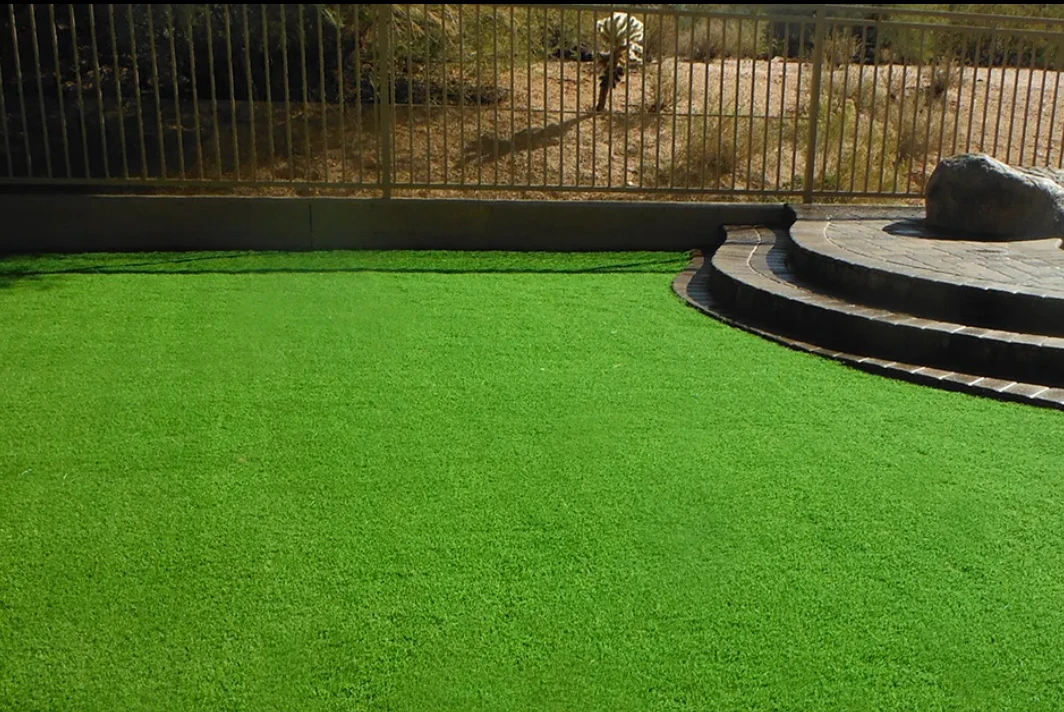
Play Area Turf
in Albuquerque
Padded turf under swing sets, playsets and climbers, so kids land on something softer than dirt, gravel or a hard base.
Call (505) 407-8448Thanks! We got it.
We'll reach out today to set up your free on-site measure. Need us sooner? Call (505) 407-8448.
Why Padded Turf Works for Play Areas
Most backyard playsets in Albuquerque end up sitting on dirt, pea gravel or wood chips. Dirt packs down hard and turns to mud after a storm. Gravel and chips get kicked out of place, so the spot under the swing that needs cushion the most ends up thin. Chips also blow around in spring wind and splinter over time.
Play area turf is a two-part system: a shock-absorbing foam pad underneath and artificial grass on top. The pad does the safety work. The turf gives kids a clean, even surface that stays put, doesn't track mud into the house, and doesn't need raking back into place every weekend.
Fall Height and Foam Padding
The pad is the most important choice in a play area, and it is not one-size-fits-all. Thickness is matched to the fall height of your play equipment.
What fall height means
Fall height is the distance from the highest place a child is meant to stand, sit or climb down to the surface below. For a playset it is usually the top deck or platform. For a swing it is measured from the height of the pivot point where the swing hangs. A tall fort or a big swing beam needs more cushion than a low toddler set.
How padding is rated
ASTM F1292 is the standard test for impact attenuation of playground surfacing. Pad and turf systems are drop-tested and given a critical fall height, which is the highest fall the system is rated to cushion. Thicker pads generally carry higher ratings. We select a pad system whose tested rating meets or exceeds the fall height of your equipment.
Use zones
The padding has to extend past the equipment, not just sit under it. The U.S. Consumer Product Safety Commission's playground guidance calls for protective surfacing around equipment, generally at least 6 feet in every direction, with longer zones in front of and behind swings. We lay out the padded area based on your playset's footprint and that guidance.
We install padded surfacing, but we are not a playground certification service. Schools, daycares and public sites that need a formal impact test usually hire a third-party inspector.
Materials for a Play Area
- Turf fibers. Play areas do best with a dense, shorter polyethylene turf, often around 1.25 to 1.5 inches. It feels soft on skin, stands up to running and sliding, and is easy to keep clean.
- Backing. We use backing that drains well, since water has to pass through both the turf and the pad below.
- Foam pad. A closed-cell or drainage-channel foam underlayment sits between the base and the turf. Its thickness is set by your fall height.
- Infill. Padded systems typically need less infill than a regular lawn. Options include silica sand, coated sand and organic infills. Many families prefer to skip crumb rubber, and we can talk through the tradeoffs.
- Base. A compacted crushed rock base keeps the surface level so the pad sits evenly with no soft spots or dips.
How We Install Play Area Turf
- Measure and plan. At the free on-site visit we measure your equipment and its fall height, mark the use zone, and give you a written quote.
- Excavate. We dig out the old dirt, chips or gravel deep enough for the base, pad and turf to finish level with the surrounding yard, so there is no tripping edge.
- Base and grade. Crushed base is spread and compacted in layers and graded so water drains away from the play area.
- Lay the pad. Foam panels are fitted tight together, with no gaps, across the whole use zone.
- Install the turf. Turf is rolled out over the pad, seamed, and secured at the edges. We cut cleanly around playset legs and anchors.
- Infill and brush. A light layer of infill is brushed in, and we walk the area with you before we leave.
Most play areas take 1 to 3 days. If you are buying a new playset, it helps to have it assembled or at least placed before we finalize the layout.
Drainage and Heat in the High Desert
At more than 5,000 feet, Albuquerque gets intense UV. We use turf with UV stabilizers so the color and fibers hold up, backed by a manufacturer warranty of up to 15 years.
Heat. Turf in direct afternoon sun gets hot, and kids notice. Shade makes the biggest difference: place the play area near a tree, add a shade sail, or orient the set so the slide doesn't face west. Lighter or heat-reflective fibers and a quick hose-down before play also help.
Monsoon storms. A summer downpour has to drain through the turf and the pad. We grade the base and choose pads with drainage channels or perforations so water moves down and out instead of sitting under the surface.
Caliche, sandy soil and wind. Caliche layers can trap water, so we break through or route drainage around them. Sandy soils on the West Side need solid compaction to keep the surface level. Secured edges and seams keep spring wind from lifting the turf.
Cost and Upkeep
Play areas with padding cost more per square foot than a standard lawn, because of the foam and the extra prep. A regular residential lawn usually runs $10 to $16 per square foot all-in. See our artificial turf cost guide for Albuquerque for what moves the price, and we give you an exact written number after measuring.
Upkeep is easy: blow off leaves, rinse spills, and brush high-traffic spots under swings where fibers lay down. Many families pair a play area with a larger artificial grass lawn in Albuquerque so the whole yard matches. Every install includes our 2-year workmanship guarantee.
Play Area Turf Questions
How thick does the padding need to be?
It depends on the fall height of your equipment. Pads are tested under ASTM F1292 and rated for a critical fall height. We measure your playset and choose a pad rated at or above that height. Taller sets need thicker padding.
Can you put turf under a playset we already have?
Yes. We can often work around an existing set, or move it aside during the install and reset it afterward. We check your equipment's height and footprint at the on-site visit.
Is play area turf safe for young kids?
Padded turf is softer than dirt, compacted gravel or a bare base, and it stays evenly in place where loose chips get kicked away. No surface prevents every injury. Matching the pad to the fall height and keeping the use zone covered are what matter most.
Do you use crumb rubber infill?
We don't have to. Padded play areas need less infill, and sand, coated sand and organic options all work. We go over the choices with you.
Does the turf get hot for kids?
It can in direct summer sun, like slides and decks do. Shade, lighter fibers and a quick rinse before playtime all help. Many families plan the play area under a tree or add a shade sail.
How much does play area turf cost?
It costs more per square foot than a standard lawn because of the foam pad and extra prep. The final price depends on the size of the use zone and the pad thickness your equipment needs. The measure and written quote are free.
Related Services & Areas
Artificial Grass Lawns
Front and back yard lawns built on a compacted, draining base.
Pet Turf & Dog Runs
Turf for yards shared by kids and dogs.
Artificial Turf Cost
How size, prep and padding affect your price.
Artificial Turf in Albuquerque
All of our turf services, photos of our work and answers to common questions.